
GST REGISTRATION
Quick Enquiry
GOODS & SERVICES TAX (GST)
Complete GST Registration & Compliance Solutions for Your Business
Goods and Services Tax (GST) is a comprehensive, multi-stage, destination-based indirect tax that has replaced a multitude of Central and State taxes in India since its introduction on 1 July 2017. It is levied on the supply of goods and services across the country and is governed by the Central Goods and Services Tax Act, 2017 (CGST Act), complemented by State GST (SGST), Integrated GST (IGST), and Union Territory GST (UTGST) Acts.
GST follows the principle of 'one nation, one tax' — unifying the indirect tax structure of India and creating a seamless national market. It is collected at each stage of the supply chain, with credit available for taxes paid at previous stages (Input Tax Credit), ensuring that the tax burden ultimately falls only on the end consumer.
At BusinessSachiv, we provide end-to-end GST services — from registration and invoicing guidance to monthly return filing, annual returns, assessments, and GST advisory — keeping your business fully compliant so you can focus on growth.
Legal Framework & Governing Acts
GST in India is administered through four main Acts:
- levied by the Central Government on intra-state supply of goods and servicesCentral GST (CGST) Act, 2017
- levied by respective State Governments on intra-state supplyState GST (SGST) Act, 2017
- levied by the Central Government on inter-state supply of goods and services, and on importsIntegrated GST (IGST) Act, 2017
- applicable to Union Territories without their own legislatureUnion Territory GST (UTGST) Act, 2017
The GST Council, a constitutional body comprising the Union Finance Minister and Finance Ministers of all States, governs GST policy, rates, and amendments in India.


Why GST Registration Matters for Your Business
- mandatory registration and compliance once your turnover crosses the thresholdLegal mandate
- registered businesses can claim credit for GST paid on purchases, reducing overall tax costInput Tax Credit (ITC)
- a valid GSTIN is required by most large businesses before entering into commercial relationshipsBusiness credibility
- IGST mechanism allows frictionless supply across state bordersSeamless inter-state trade
- a valid GST registration is typically a prerequisite for government procurementGovernment tenders & contracts
- operating without registration when liable attracts significant penalties and interestAvoids penalties
- all sellers on platforms like Amazon, Flipkart, and Meesho must have GST registration regardless of turnoverE-commerce selling
- registered exporters can claim refunds of IGST paid on exports or export on a Letter of Undertaking (LUT)Export benefits
Who Must Register for GST?
GST registration is mandatory for the following categories of persons/businesses:
|
Category |
Turnover Threshold |
|
Supplier of Goods (General Category States) |
Annual aggregate turnover exceeds ₹40 Lakhs |
|
Supplier of Services (General Category States) |
Annual aggregate turnover exceeds ₹20 Lakhs |
|
Supplier of Goods (Special Category States) |
Annual aggregate turnover exceeds ₹20 Lakhs |
|
Supplier of Services (Special Category States) |
Annual aggregate turnover exceeds ₹10 Lakhs |
|
E-Commerce Operators & Sellers |
Mandatory regardless of turnover |
|
Inter-State Suppliers |
Mandatory regardless of turnover |
|
Casual Taxable Persons |
Mandatory regardless of turnover |
|
Non-Resident Taxable Persons |
Mandatory regardless of turnover |
|
Persons liable to pay tax under Reverse Charge |
Mandatory regardless of turnover |
|
Input Service Distributors (ISD) |
Mandatory regardless of turnover |
Special Category States include: Jammu & Kashmir, Himachal Pradesh, Uttarakhand, Arunachal Pradesh, Meghalaya, Mizoram, Tripura, Manipur, Nagaland, Sikkim, and Assam.
GST Rate Structure
GST is levied under a multi-tier rate structure based on the nature of goods and services:
|
GST Rate |
Category |
Examples |
|
0% (Nil) |
Essential commodities |
Fresh vegetables, milk, eggs, bread, educational services, healthcare |
|
5% |
Mass consumption goods |
Packaged food items, transport services, small restaurants |
|
12% |
Standard goods & services |
Processed food, mobile phones, business class air travel |
|
18% |
Most goods & services |
IT services, professional services, most manufactured goods |
|
28% |
Luxury & sin goods |
Automobiles, tobacco, aerated drinks, premium appliances |
|
Special Rates |
Gold, precious metals |
Gold: 3%, Cut diamonds: 0.25% |
Additionally, a Compensation Cess is levied on certain luxury/sin goods over and above the 28% rate. GST rates are notified by the GST Council and revised periodically.
Types of GST Registration
- for businesses with turnover above the threshold or mandatorily required to registerRegular Registration
- for small businesses with aggregate turnover up to ₹1.5 Crore (₹75 Lakhs for services), allowing a simplified flat-rate tax with restrictions on ITC and inter-state supplyComposition Scheme
- for businesses making taxable supply in a state where they have no fixed place of business, valid for up to 90 daysCasual Taxable Person Registration
- for foreign persons/entities supplying goods/services in India temporarilyNon-Resident Taxable Person
- for businesses distributing input tax credit across branchesInput Service Distributor (ISD)
- for Government entities required to deduct TDS under GSTTDS Deductor Registration
- for platforms facilitating online supply of goods/servicesE-Commerce Operator Registration
Documents Required for GST Registration
For Proprietorship:
- PAN Card and Aadhaar Card of the proprietor
- Passport-size photograph of the proprietor
- Proof of business address (electricity bill / rent agreement / NOC from owner)
- Bank account details — cancelled cheque or bank statement
For Partnership / LLP:
- PAN Card of the firm and all partners/designated partners
- Partnership deed / LLP agreement
- Proof of principal place of business
- Authorization letter for the authorized signatory
For Private Limited / Public Limited Company:
- PAN Card of the company
- Certificate of Incorporation from MCA
- Memorandum and Articles of Association
- PAN and Aadhaar of all directors
- Board resolution authorizing the signatory
- Proof of registered office address
Digital Signature Certificate (DSC) is required for company and LLP registration. All documents must be uploaded in the prescribed format on the GST Portal (www.gst.gov.in).
Why Choose BusinessSachiv for GST Services
- End-to-end GST registration, return filing, and annual compliance management
- Accurate ITC reconciliation to maximize eligible input tax credit
- Timely return filing — never miss a due date with our compliance calendar
- Expert drafting of replies to GST notices with document-backed submissions
- Full representation in GST assessments, scrutiny, and audit proceedings
- Appeal filing and representation before Commissioner (Appeals) and GST Appellate Tribunal
- E-invoicing and e-way bill setup and support
- Multi-state GSTIN management for businesses with presence across states
- Dedicated GST manager for your account — one point of contact from registration to litigation
- Transparent, affordable pricing — no hidden charges
Get Personalized GST Guidance
Our GST experts at BusinessSachiv are ready to guide you through registration, return filing, ITC reconciliation, notice replies, assessments, and appeals — from GSTIN allotment to the Appellate Tribunal — with a free, no-obligation consultation.
Schedule your free consultation today.
1. What is a GSTIN?
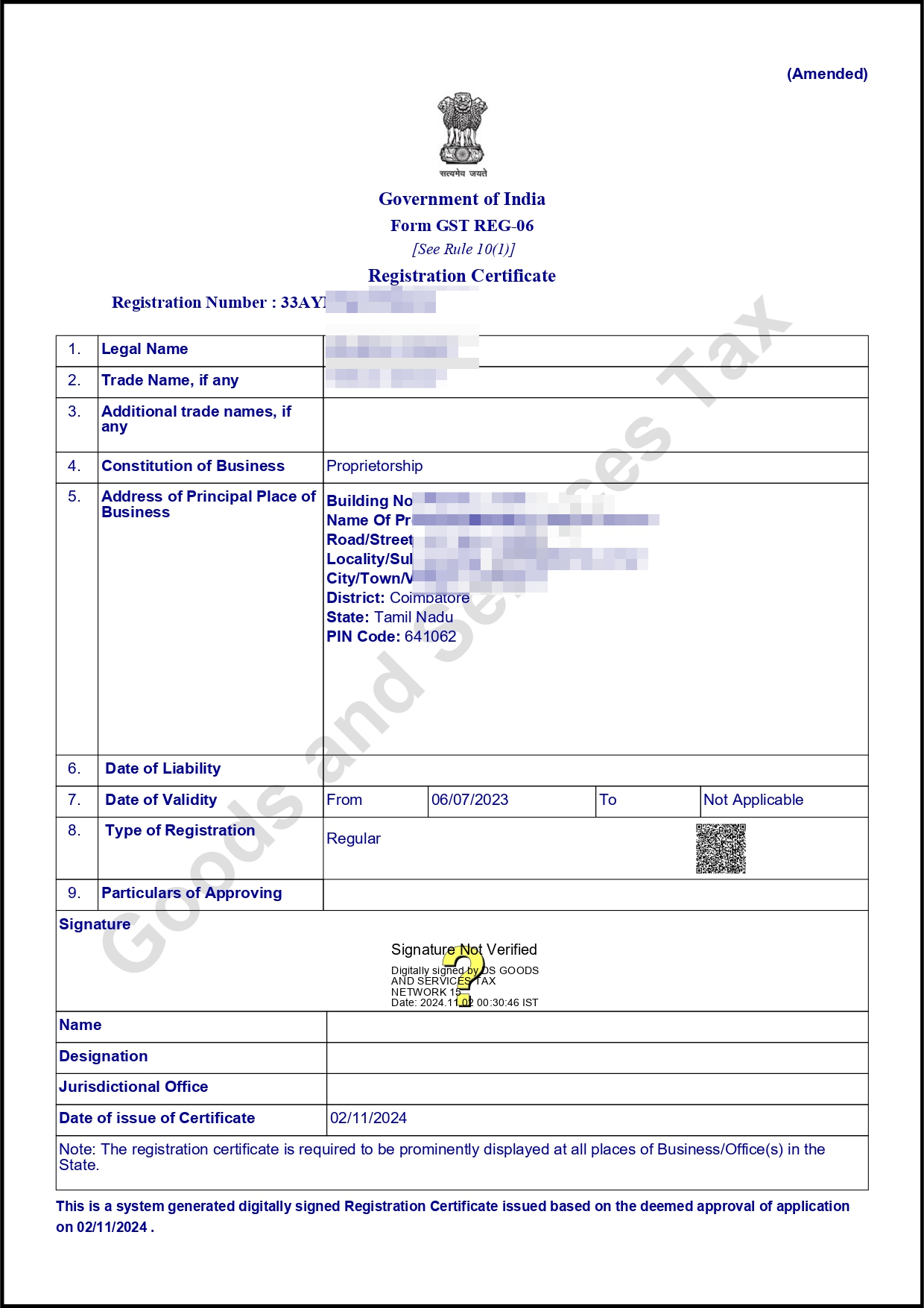
GSTIN (Goods and Services Tax Identification Number) is a unique 15-digit alphanumeric number allotted to every GST-registered taxpayer. The first 2 digits represent the state code, the next 10 are the PAN of the entity, followed by entity number, blank, and check digit.
2. Can I register for GST voluntarily if my turnover is below the threshold?
Yes, voluntary GST registration is allowed. It can be beneficial if your customers are primarily GST-registered businesses who need to claim ITC on purchases from you.
3. What is the Composition Scheme and who should opt for it?
The Composition Scheme is a simplified tax option for small taxpayers with annual aggregate turnover up to ₹1.5 Crore (₹75 Lakh for service providers), allowing them to pay a flat rate of tax without the requirement to maintain detailed invoice-level records or file monthly returns. However, they cannot claim ITC or make inter-state supplies.
4. Can a GST registration be cancelled?
Yes, GST registration can be cancelled voluntarily if the business is closed or no longer liable, or it may be cancelled suo-motu by the officer for non-compliance.
5. What is an e-invoice under GST?
E-invoicing is a system where B2B invoices are electronically authenticated by the GSTN Invoice Registration Portal (IRP) and assigned an IRN (Invoice Reference Number). It is currently mandatory for businesses with aggregate turnover above ₹5 Crore.
6. What is the difference between CGST, SGST, and IGST?
CGST and SGST are levied in equal proportions on intra-state (within the same state) supplies and are collected by the Centre and State respectively. IGST is levied on inter-state supplies (between two different states) and is collected entirely by the Centre, which then apportions the state's share.
7. What is Reverse Charge Mechanism (RCM) under GST?
Under RCM, the recipient of goods/services is liable to pay GST instead of the supplier. It applies in certain specified transactions — for example, purchases from unregistered dealers in specific categories or specified services like legal services from individual advocates.
8. How is GST different from the old VAT/Service Tax regime?
Under the old regime, multiple taxes like VAT, Central Excise, Service Tax, Octroi, and Entry Tax were levied at different stages, often cascading into each other. GST replaced all of these with a single, unified tax with a seamless ITC mechanism, eliminating the cascading effect and simplifying compliance.
9. What is an e-way bill and when is it required?
An e-way bill is an electronic document required for the movement of goods valued at ₹50,000 or more within India. It must be generated before the goods begin their journey and is verified at check posts by tax authorities.
10. Do freelancers and consultants need GST registration?
Yes, if their annual aggregate turnover from services exceeds ₹20 Lakhs (₹10 Lakhs in special category states), or if they provide services inter-state, they must register for GST regardless of turnover.
11. Can I have multiple GSTINs for one business?
Yes, if a business operates in multiple states, a separate GSTIN must be obtained for each state where it has a business presence. Additionally, different business verticals within the same state may optionally obtain separate GSTINs.
12. What happens if I file GST returns late?
Late filing attracts a late fee of ₹50 per day (₹25 CGST + ₹25 SGST) per return, or ₹20 per day for Nil returns, subject to maximum caps notified by the government. Interest at 18% per annum is also applicable on outstanding tax liability.
Schedule Your Consultation
Affordable & Transparent Pricing, Tailored to Your Growth — covering everything from Incorporation to Year-round Compliance
B-Basic
₹3999 ₹2999
What's Included
- Reserve Company name at MCA
- Expert advice on incorporation
- Filing of incorporation documents at MCA
- MCA Processing
- Company CIN, PAN, TAN
- Memorandum of Association
- Articles of Associations
- DIN for 2 directors
 Enquiry Now
B-Gold
₹34999 ₹14999
What's Included
- B-Silver Service
- Filing of Commencement of Business
- Creation of Directors Credential on MCA
- Registration of Directors DSC on MCA
- Conducting & Convening 1st Board Meeting of Company
- Appointment of Auditor
Enquiry Now
B-Plantinum
₹39999 ₹19999
What's Included
- B-Gold Service
- Appointment of Auditor
- Filing of DIR-3
- Filing of DPT-3 (Deposit Statement)
- Filing of AOC-4 (Financial Statement)
- Accounting and booking for 1 Year
- Preparation of Financial Statement
- GST-1 Filing for 12 months
- GSTR-3B filing for 12 Month
- GSTR-9 filing for 12 months
- Income Tax return filing
- TDS return filing for 1 Year
Enquiry Now
B-Diamond
₹49999 ₹29999
What's Included
- B-Platimum Services
- MSME Registration
- Shop & Establishment Registration
- Convening & Conducting Board Meeting for 1 Year
- Drafting of Notice aling with Agenda for Board meeting for 1 Year
- Drafting of Board Resolutions for 1 Years
- Drafting of Minutes of Board Meetings
- Convening & Conducting AGM/EGM for 1 Year
- Drafting of Notice aling with Agenda for GM/EGM for 1 Year
- Drafting of GM/EGM Resolutions for 1 Years
- Drafting of Minutes of GM/EGM Meetings
- 1 Year Consultancy for GST Compliance
- 1 Year Consultancy for Income Compliance
- 1 Year Consultancy for ROC Compliance
- Filing of Application for Trademark
Enquiry Now
B-Special Package
₹69999 ₹49000
What's Included
- B-Diamond Services
- Running a Awareness Campaign, Traffic Campaign, Lead Generation Campaign Social Media on behalf of Company like Facebook, Instagram, Youtube for 6 Months (Excluding Ad Budget)
Enquiry Now
Why Choose BusinessSachiv
We make technical compliance certifications effortless and convenient.

Trust
Your Growth, Our Priority

Google Verified
Recognized on Google Search

Top
Industry Professionals

100%
Satisfaction Guaranteed
What Our Clients Say About BusinessSachiv
Join 500+ businesses who rely on BusinessSachiv for financial clarity and strategic growth

“As a founder, I was overwhelmed by financial stuff. BusinessSachiv took the pressure off and helped us prepare investor-ready reports that secured funding.”
Rakesh Kumar
Businessman“We saved thousands on taxes and now have monthly reports that actually help us make decisions. BusinessSachiv is more than an accountant — they’re a partner.”
Kavita Mishra
CFO, IUBT“Their financial dashboard helped us finally understand where our money was going. With their support, we’ve grown faster and smarter.”
Meena Desai
CEO & CO-Founder“BusinessSachiv’s team set up our nonprofit accounting system and guided us through every step of donor reporting. Their clarity made a huge difference.”
Amit Verma
Entrepreneur“BusinessSachiv transformed our messy financials into a streamlined system we can trust. Their team feels like an extension of our business.”
Rajesh Sharma
EntrepreneurGet started?
We also help you market your products through an online marketplace.
Fill up Application Form
Make Online Payment
Executive will Process Application
Get Confirmation Mail
OUR ESTEEMED CLIENTS