

GST RETURN
Quick Enquiry
What is a GST Return?
A GST return is a statement every GST-registered taxpayer files with the tax authorities, reporting outward supplies (sales), inward supplies (purchases), Input Tax Credit claimed, and tax payable. It's how the government verifies your net liability and cross-checks that your ITC claims line up with what your suppliers have reported. Getting this right — and on time — keeps your business compliant and your credit flowing.
Types of GST Returns & Due Dates
|
Return |
Filed by |
Frequency |
Due date |
|
GSTR-1 |
All regular taxpayers (sales) |
Monthly / QRMP |
11th of next month · 13th after quarter (QRMP) |
|
GSTR-3B |
All regular & casual taxpayers |
Monthly / QRMP |
20th of next month · 22nd/24th after quarter |
|
GSTR-2B |
Auto-generated, view only |
Monthly |
14th of following month |
|
CMP-08 |
Composition dealers |
Quarterly |
18th after quarter-end |
|
GSTR-4 |
Composition dealers (annual) |
Annually |
30th April, next FY |
|
GSTR-5 |
Non-resident taxable persons |
Monthly |
20th of next month |
|
GSTR-6 |
Input Service Distributors |
Monthly |
13th of next month |
|
GSTR-7 |
TDS deductors |
Monthly |
10th of next month |
|
GSTR-8 |
E-commerce operators (TCS) |
Monthly |
10th of next month |
|
GSTR-9 |
All regular taxpayers (annual) |
Annually |
31st December, next FY |
|
GSTR-9C |
Turnover above ₹5 crore |
Annually |
31st December, next FY |
|
Good to know — due dates can be extended via CBIC notification, especially after portal outages. BusinessSachiv tracks these updates so you never miss a deadline. |


The Returns That Matter Most
GSTR-1 — Sales Report
Invoice-level detail of every outward supply for the period. This flows into your buyers' GSTR-2B, so timely filing keeps your customers' ITC claims on track.
GSTR-3B — Summary Return
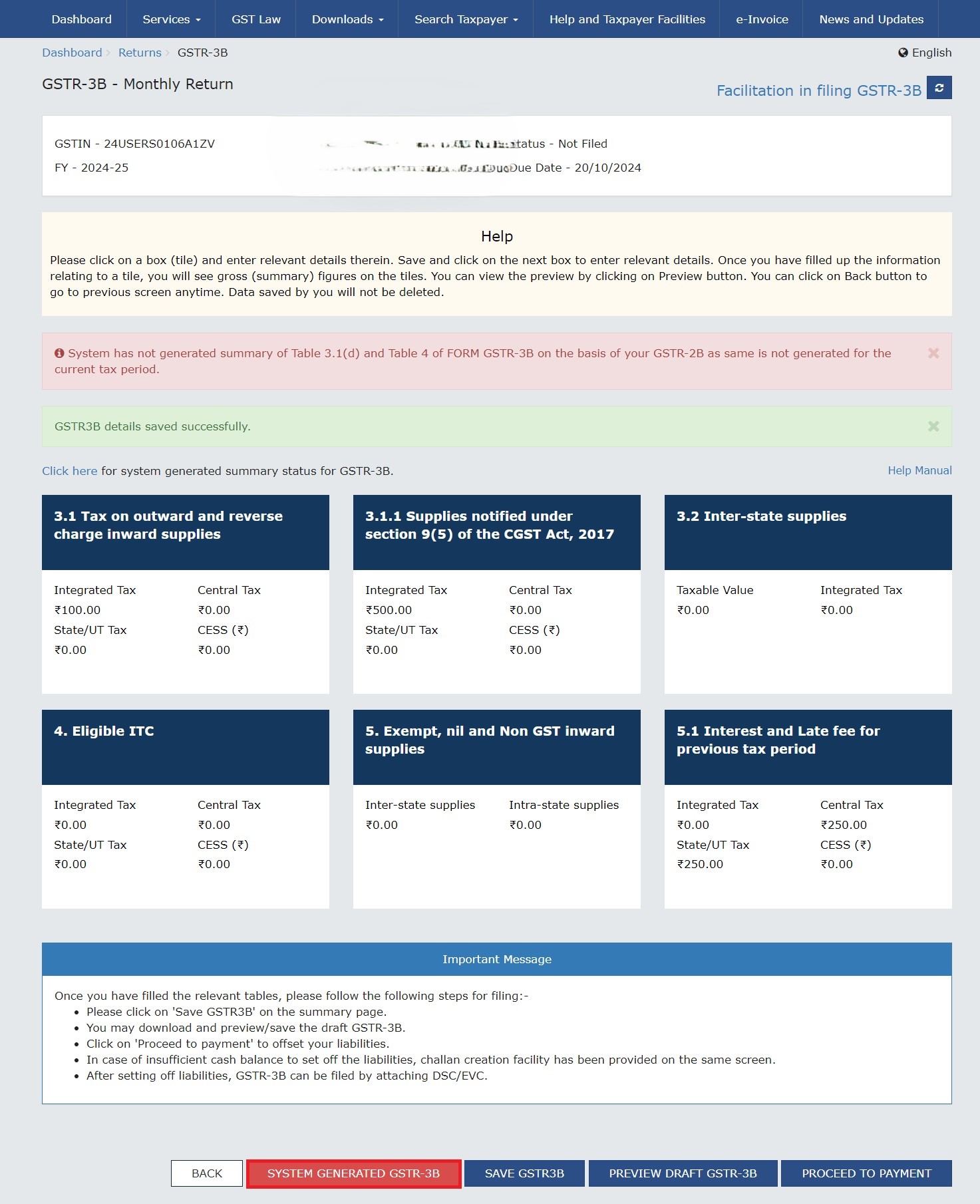
A self-declared summary of sales, ITC, and net tax payable, filed with actual payment. Auto-populated fields are largely locked — corrections route through GSTR-1A first.
QRMP Scheme
Businesses up to ₹5 crore turnover can file GSTR-1/3B quarterly, while still paying tax monthly via Form PMT-06. The optional IFF speeds up ITC for your buyers.
GSTR-9 & 9C — Annual Return
A consolidated year-end summary of your filings. Businesses above ₹5 crore turnover also need GSTR-9C, certified by a CA or Cost Accountant.
The Cost of Filing Late
|
₹50/day |
Regular GSTR-1/3B — capped ₹2,000–₹10,000 by turnover |
|
₹20/day |
Nil return — capped at ₹500 |
|
₹200/day |
GSTR-9 annual return — capped at 0.25% of turnover |
|
18% p.a. |
Interest on unpaid tax, from the due date |
|
Two rules to remember — filing is sequential (a later period can't be filed while an earlier one is pending), and returns become permanently unfileable once three years past their original due date. |
Filing a Return, Step by Step
1. Log in to the GST portal with your credentials.
2. Go to Services → Returns → Returns Dashboard.
3. Select the financial year and tax period.
4. Choose the applicable return — GSTR-1, GSTR-3B, and so on.
5. Review data auto-populated from GSTR-1/1A and GSTR-2B.
6. Reconcile ITC and confirm your cash/credit ledger balance.
7. Submit and file using DSC or EVC.
Good Habits, Kept
✓ Reconcile early. Match purchase records to GSTR-2B before filing.
✓ File on time, always. Even nil returns need filing to avoid fees.
✓ Automate the busywork. Good software cuts reconciliation errors.
✓ Track extensions. Follow the live GST portal calendar, not fixed dates.
✓ Clear the backlog. Don't let old pending returns cross the 3-year cutoff.
✓ Get expert support. A dedicated compliance partner catches what's easy to miss.
Frequently Asked Questions
Q1. What is a GST return?
A statement filed by every GST-registered taxpayer, reporting sales, purchases, tax collected, tax paid, and Input Tax Credit claimed for a given period.
Q2. Who needs to file GST returns?
Every GST-registered entity — regular taxpayers, composition dealers, e-commerce operators, Input Service Distributors, non-resident taxable persons, and TDS/TCS deductors — though the exact forms and frequency vary by category.
Q3. Which returns matter most for a typical business?
GSTR-1 (sales), GSTR-3B (summary and tax payment), and GSTR-9 (annual return) cover most businesses' compliance needs.
Q4. What's the difference between GSTR-1 and GSTR-3B?
GSTR-1 reports invoice-level detail of your sales. GSTR-3B is the summary return where you declare total liability, claim ITC, and actually pay tax.
Q5. What is the QRMP scheme and who can use it?
QRMP lets businesses with turnover up to ₹5 crore file GSTR-1 and GSTR-3B quarterly while still paying tax monthly via Form PMT-06 — a lighter filing load with the same cash-flow discipline.
Q6. What happens if I miss a due date?
A late fee (₹50/day, or ₹20/day for nil returns, capped by turnover) plus 18% annual interest on unpaid tax — and you're blocked from filing later periods until the pending one clears.
Q7. Is a late nil return penalized the same way?
No — it's lighter: ₹20/day (₹10 CGST + ₹10 SGST), capped at ₹500, versus ₹50/day for a return with actual transactions.
Q8. Can I file GSTR-3B without paying the tax due?
No. Your electronic cash or credit ledger needs sufficient balance before you can offset and file — generate a challan and pay first if funds are short.
Q9. What is GSTR-2B, and do I file it myself?
It's an auto-generated, view-only statement of your eligible and ineligible ITC based on suppliers' filings. You don't file it — you use it to reconcile before filing GSTR-3B.
Q10. Why is a valid purchase invoice's ITC not showing up?
If your supplier hasn't filed their GSTR-1, the invoice won't appear in your GSTR-2B, and credit generally stays deferred until they do — worth following up directly with chronically late suppliers.
Q11. Can I revise a GST return after filing?
There's no formal revision facility. Corrections to outward supply data typically go through GSTR-1A for the same period, or an amendment in a later period's GSTR-1/IFF.
Q12. When is the annual return, GSTR-9, due?
31st December following the end of the financial year — for FY 2025–26, that's 31st December 2026.
Q13. Who has to file GSTR-9C?
Taxpayers with turnover above ₹5 crore — it's a reconciliation statement between annual returns and audited financials, certified by a CA or Cost Accountant.
Q14. Is there a cutoff after which an old return can never be filed?
Yes — three years past the original due date. After that, the tax period is permanently blocked, with no way to file it.
Q15. Do composition dealers file the same returns as regular taxpayers?
No — they file a simplified quarterly statement (CMP-08) and one annual return (GSTR-4), rather than the regular GSTR-1/GSTR-3B cycle.
Q16. Is my GSTR-3B due on the 20th, or the 22nd/24th?
Monthly filers (typically above ₹5 crore turnover, or not on QRMP) file by the 20th. QRMP filers split by state group — 22nd for one group, 24th for the other.
Q17. How can BusinessSachiv help with GST return filing?
We handle end-to-end GST compliance — registration, monthly/quarterly return filing, ITC reconciliation, and annual returns — so deadlines are never missed and your credit stays clean.
This guide is for general information only and isn't professional tax advice. GST rules change via CBIC notifications — verify current requirements on the official GST portal or with a BusinessSachiv advisor.
Schedule Your Consultation
Affordable & Transparent Pricing, Tailored to Your Growth — covering everything from Incorporation to Year-round Compliance
B-Basic
₹3999 ₹2999
What's Included
- Reserve Company name at MCA
- Expert advice on incorporation
- Filing of incorporation documents at MCA
- MCA Processing
- Company CIN, PAN, TAN
- Memorandum of Association
- Articles of Associations
- DIN for 2 directors
 Enquiry Now
B-Gold
₹34999 ₹14999
What's Included
- B-Silver Service
- Filing of Commencement of Business
- Creation of Directors Credential on MCA
- Registration of Directors DSC on MCA
- Conducting & Convening 1st Board Meeting of Company
- Appointment of Auditor
Enquiry Now
B-Plantinum
₹39999 ₹19999
What's Included
- B-Gold Service
- Appointment of Auditor
- Filing of DIR-3
- Filing of DPT-3 (Deposit Statement)
- Filing of AOC-4 (Financial Statement)
- Accounting and booking for 1 Year
- Preparation of Financial Statement
- GST-1 Filing for 12 months
- GSTR-3B filing for 12 Month
- GSTR-9 filing for 12 months
- Income Tax return filing
- TDS return filing for 1 Year
Enquiry Now
B-Diamond
₹49999 ₹29999
What's Included
- B-Platimum Services
- MSME Registration
- Shop & Establishment Registration
- Convening & Conducting Board Meeting for 1 Year
- Drafting of Notice aling with Agenda for Board meeting for 1 Year
- Drafting of Board Resolutions for 1 Years
- Drafting of Minutes of Board Meetings
- Convening & Conducting AGM/EGM for 1 Year
- Drafting of Notice aling with Agenda for GM/EGM for 1 Year
- Drafting of GM/EGM Resolutions for 1 Years
- Drafting of Minutes of GM/EGM Meetings
- 1 Year Consultancy for GST Compliance
- 1 Year Consultancy for Income Compliance
- 1 Year Consultancy for ROC Compliance
- Filing of Application for Trademark
Enquiry Now
B-Special Package
₹69999 ₹49000
What's Included
- B-Diamond Services
- Running a Awareness Campaign, Traffic Campaign, Lead Generation Campaign Social Media on behalf of Company like Facebook, Instagram, Youtube for 6 Months (Excluding Ad Budget)
Enquiry Now
Why Choose BusinessSachiv
We make technical compliance certifications effortless and convenient.

Trust
Your Growth, Our Priority

Google Verified
Recognized on Google Search

Top
Industry Professionals

100%
Satisfaction Guaranteed
What Our Clients Say About BusinessSachiv
Join 500+ businesses who rely on BusinessSachiv for financial clarity and strategic growth

“As a founder, I was overwhelmed by financial stuff. BusinessSachiv took the pressure off and helped us prepare investor-ready reports that secured funding.”
Rakesh Kumar
Businessman“We saved thousands on taxes and now have monthly reports that actually help us make decisions. BusinessSachiv is more than an accountant — they’re a partner.”
Kavita Mishra
CFO, IUBT“Their financial dashboard helped us finally understand where our money was going. With their support, we’ve grown faster and smarter.”
Meena Desai
CEO & CO-Founder“BusinessSachiv’s team set up our nonprofit accounting system and guided us through every step of donor reporting. Their clarity made a huge difference.”
Amit Verma
Entrepreneur“BusinessSachiv transformed our messy financials into a streamlined system we can trust. Their team feels like an extension of our business.”
Rajesh Sharma
EntrepreneurGet started?
We also help you market your products through an online marketplace.
Fill up Application Form
Make Online Payment
Executive will Process Application
Get Confirmation Mail
OUR ESTEEMED CLIENTS