

GST NOTICE
Quick Enquiry
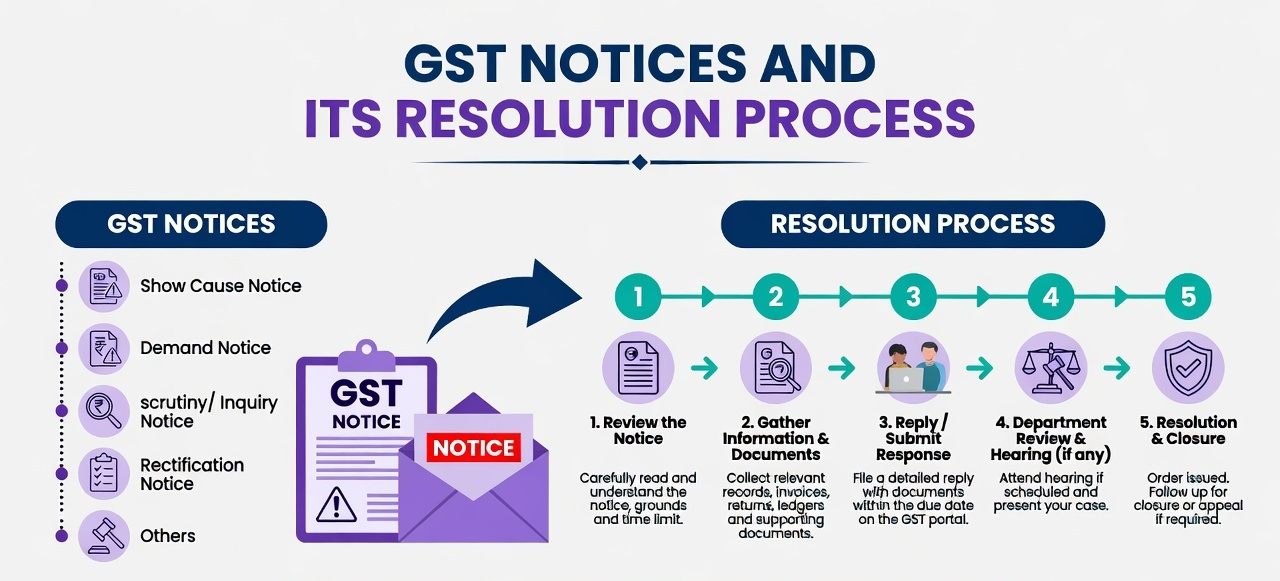
GST NOTICES AND ITS RESOLUTION
Receiving a GST notice can be stressful, but it is a common part of GST compliance. Notices are issued by GST authorities for a variety of reasons — from seeking clarification on returns to demand of tax, interest, and penalty. Prompt, accurate, and well-reasoned replies are critical to resolving notices without escalation.
Common types of GST notices and their provisions:
|
Notice / Form |
Section |
Reason Issued |
Response Time |
|
GST REG-03 |
Section 25 |
Seeking additional information/documents during registration |
Within 7 working days |
|
GST REG-17 / 19 |
Section 29 |
Show Cause Notice for cancellation of registration |
Within 7 working days |
|
ASMT-10 |
Section 61 |
Scrutiny of returns — discrepancies noticed |
Within 30 days |
|
DRC-01 |
Section 73/74 |
Summary of demand — tax, interest, and penalty |
Within 30 days |
|
DRC-01A |
Section 73/74 |
Pre-show cause notice intimation for demand |
Within 30 days |
|
DRC-16 |
Section 79 |
Notice for recovery of outstanding demand |
As specified |
|
GSTR-3A |
Section 46 |
Notice for non-filing of GST returns |
Within 15 days |
|
ADT-01 |
Section 65/66 |
Notice for GST audit / special audit |
Within 30 days |
Response timelines are critical — failure to respond within the prescribed period may result in ex-parte orders, demand confirmation, or prosecution proceedings.
How BusinessSachiv handles GST notices for you:
- Detailed analysis of the notice — understanding the exact nature of demand or query
- Comprehensive review of relevant transactions, invoices, returns, and ITC records
- Drafting a legally sound, factually accurate reply with supporting documentation
- Filing the reply electronically on the GST portal within the prescribed timeline
- Personal representation before the GST officer, if required
- Follow-up to ensure the notice is resolved without further escalation
Early engagement with professionals is critical — do not ignore GST notices. A missed deadline can convert a clarification notice into a confirmed demand with interest and penalty.


GST Assessment
A GST assessment is the process by which tax authorities determine the correct amount of GST payable by a taxpayer. Under the GST framework, assessments can be initiated suo-motu by the officer or pursuant to audit findings, return scrutiny, or specific intelligence.
Types of GST Assessments under the CGST Act, 2017:
- — Every registered taxpayer is expected to self-assess their tax liability and file returns accordingly. This is the primary mode of assessment under GST.Self-Assessment (Section 59)
- — Where a taxpayer is unable to determine the value or applicable rate of tax, they may request provisional assessment from the officer, with final assessment to follow.Provisional Assessment (Section 60)
- — The officer may scrutinize filed returns for discrepancies and issue ASMT-10, requiring explanation or payment of differential tax.Scrutiny Assessment (Section 61)
- — Where a registered person fails to file returns even after notice, the officer may assess tax liability to the best of their judgment, based on available information.Best Judgment Assessment — Non-Filer (Section 62)
- — Where a taxable person fails to obtain registration despite being liable, the officer may assess their tax liability.Best Judgment Assessment — Unregistered Person (Section 63)
- — In cases of imminent threat to tax revenue, the officer may issue a summary assessment order without hearing the taxpayer, upon prior permission of the Additional/Joint Commissioner.Summary Assessment (Section 64)
Assessment proceedings typically involve:
- Issuance of Show Cause Notice (SCN) in Form DRC-01 specifying the alleged demand
- Taxpayer's opportunity to file a reply and produce evidence
- Personal hearing before the adjudicating authority (if requested or deemed necessary)
- Issuance of Assessment Order in Form DRC-07 confirming or modifying the demand
- Recovery proceedings if demand is confirmed and remains unpaid
BusinessSachiv provides complete representation and advisory throughout the assessment process — from SCN analysis to final order, ensuring your case is presented with maximum factual and legal strength.
GST Scrutiny
GST return scrutiny under Section 61 of the CGST Act is a targeted compliance mechanism where the Proper Officer examines a taxpayer's filed returns for discrepancies — typically by comparing GSTR-1, GSTR-3B, GSTR-2B/2A, GSTR-9, and other available data. It is one of the most common enforcement actions businesses face.
Common grounds for GST scrutiny notices (ASMT-10):
- Mismatch between GSTR-1 (outward supplies) and GSTR-3B (tax paid)
- Excess ITC claimed in GSTR-3B compared to GSTR-2B (auto-populated credit)
- Short payment of tax compared to reported liability
- Discrepancy between GST turnover and Income Tax / TDS returns
- ITC claimed on ineligible items or from suppliers who did not file returns
- Reversal of ITC not done for exempt supplies or Rule 42/43 proportionate reversal
- Excess refund claimed or refund obtained without entitlement
- High-value transactions not reflected in GST returns
Scrutiny process — how it works:
- GST officer issues ASMT-10 notice specifying discrepancies and seeking explanation
- Taxpayer must file a reply within 30 days (extendable on application)
- If the explanation is satisfactory, officer issues ASMT-11 (acceptance) and closes the matter
- If not satisfied, the officer may initiate audit, special audit, or issue a Show Cause Notice under Section 73/74 for demand of tax, interest, and penalty
BusinessSachiv scrutiny services include:
- Detailed reconciliation of GSTR-1 vs GSTR-3B vs GSTR-2B vs books of accounts
- Analysis of ITC eligibility and identification of any inadvertent errors
- Preparation of a comprehensive, document-backed reply to ASMT-10
- Representation before the GST officer during the scrutiny process
- Proactive reconciliation services to prevent future scrutiny notices
We recommend businesses undertake a proactive internal GST health check annually — reviewing return accuracy, ITC reconciliation, and E-invoicing compliance — to minimize the likelihood of scrutiny notices.
Why Choose BusinessSachiv for GST Services
- Expert drafting of replies to GST notices with document-backed submissions
- Full representation in GST assessments, scrutiny, and audit proceedings
- Appeal filing and representation before Commissioner (Appeals) and GST Appellate Tribunal
- Dedicated GST manager for your account — one point of contact from registration to litigation
- Transparent, affordable pricing — no hidden charges
Get Personalized GST Guidance
Our GST experts at BusinessSachiv are ready to guide you through registration, return filing, ITC reconciliation, notice replies, assessments, and appeals — from GSTIN allotment to the Appellate Tribunal — with a free, no-obligation consultation.
Schedule your free consultation today.
FREQUENTLY ASKED QUESTIONS
A Quick-Reference Guide to Understanding, Responding to, and Managing Notices under the Goods and Services Tax (GST) Law
Disclaimer: This document is for general awareness only and does not constitute legal or professional advice. Please consult a qualified tax professional for guidance on any specific GST notice received.
1. General Understanding of GST Notices
Q1. What is a GST notice?
Ans: A GST notice is a formal communication issued by the GST department to a taxpayer, seeking clarification, information, or compliance regarding returns, payments, registration, or other obligations under the GST law. It may point out a discrepancy, propose a demand, or require a specific action within a stated time frame.
Q2. Why do taxpayers receive GST notices?
Ans: Notices are typically triggered by one or more of the following:
- Mismatch between GSTR-1, GSTR-3B and GSTR-2A/2B
- Non-filing or delayed filing of returns
- Discrepancies identified during scrutiny, audit, or data analytics
- Excess claim of Input Tax Credit (ITC)
- Short payment or non-payment of tax
- Non-compliance with e-way bill or e-invoicing requirements
- Refund claims requiring verification
Q3. Where are GST notices delivered?
Ans: Notices are primarily served electronically on the GST Common Portal (www.gst.gov.in) under 'View Notices and Orders', and a copy is usually also sent to the registered e-mail ID and mobile number of the taxpayer. It is advisable to check the portal periodically, as the limitation period generally runs from the date of upload on the portal, not from when the taxpayer actually reads it.
Q4. How can I check if any notice has been issued to me?
Ans: Log in to the GST portal, navigate to Services > User Services > View Notices and Orders (or the 'Additional Notices and Orders' tab), and review all pending and past communications regularly.
2. Common Types of GST Notices
Some of the most frequently issued notices and their standard response timelines are summarised below:
|
Form No. |
Notice For |
Typical Response Time |
|
GSTR-3A |
Default in filing GST returns (GSTR-1/3B etc.) |
15 days |
|
ASMT-10 |
Discrepancies noticed in returns (scrutiny) |
30 days (or as specified) |
|
DRC-01 |
Show cause notice for tax demand (Sec. 73/74) |
30 days |
|
DRC-01A |
Intimation of tax ascertained before SCN |
Response before formal SCN |
|
REG-17 |
Show cause notice for cancellation of registration |
7 working days |
|
REG-23 |
Show cause notice for revocation of cancellation |
7 working days |
|
RFD-08 |
Show cause notice for rejection of refund claim |
15 days |
|
CMP-05 |
Denial of composition scheme option |
15 days |
|
ADT-01 |
Notice for departmental audit under Sec. 65 |
As specified in notice |
3. Responding to a GST Notice
Q5. What should I do immediately on receiving a notice?
Ans: Read the notice carefully to identify the issuing authority, the relevant form/section, the specific issue raised, and the due date for response. Gather the supporting documents (returns, invoices, ledgers, reconciliations) relevant to the issue before drafting a reply.
Q6. How do I file a reply to a GST notice?
Ans: Replies are generally filed online on the GST portal against the specific notice, using the prescribed reply form (for example, ASMT-11 for ASMT-10, or DRC-06 for DRC-01). Supporting documents can be attached, and a physical/manual reply may also be permitted in certain cases if specified in the notice.
Q7. Can I request additional time to respond?
Ans: Yes, an adjournment or extension may be requested from the proper officer, generally through a written application citing genuine reasons. However, granting an extension is at the discretion of the officer, so it is safer to plan the response well within the original timeline.
Q8. Is a personal hearing available before a final order is passed?
Ans: Where a notice may result in an adverse decision (such as a demand or cancellation), the taxpayer is generally entitled to a reasonable opportunity of being heard, including a personal hearing, before a final order is issued.
4. Consequences of Non-Response or Delay
Q9. What happens if I do not reply to a GST notice within the stipulated time?
Ans: Non-response can lead to an ex-parte order being passed based on the information available with the department, which is often unfavourable to the taxpayer. It may also result in confirmation of the proposed demand, interest, and penalty, or cancellation of registration, as applicable to the type of notice.
Q10. Can a GST registration be cancelled for not responding to a notice?
Ans: Yes. If a taxpayer fails to respond to a show cause notice for cancellation (Form REG-17) within the prescribed period, the proper officer may proceed to cancel the registration.
Q11. What are the consequences of an unreplied demand notice (DRC-01)?
Ans: If no reply is filed, the proper officer may confirm the demand raised in the notice along with applicable interest and penalty, and pass an order under Section 73 or 74 of the CGST Act, as the case may be.
5. Practical Tips
Q12. What precautions should a taxpayer take to avoid GST notices?
Ans: The following practices help minimise the risk of receiving notices:
- File all GST returns accurately and within due dates
- Reconcile GSTR-1, GSTR-3B and GSTR-2B on a monthly basis
- Maintain proper documentation for all ITC claims
- Respond promptly to any intimation (e.g., DRC-01A) before it escalates to a formal notice
- Keep the registered e-mail ID and mobile number updated on the portal
Q13. Should I engage a professional to respond to a GST notice?
Ans: While simple clarificatory notices can sometimes be handled independently, notices involving demand, ITC disputes, or cancellation typically involve legal and factual analysis. Engaging a qualified GST practitioner, chartered accountant, or tax advocate is advisable to ensure the reply is legally sound and adequately supported.
Prepared for general informational purposes.
Schedule Your Consultation
Affordable & Transparent Pricing, Tailored to Your Growth — covering everything from Incorporation to Year-round Compliance
B-Basic
₹3999 ₹2999
What's Included
- Reserve Company name at MCA
- Expert advice on incorporation
- Filing of incorporation documents at MCA
- MCA Processing
- Company CIN, PAN, TAN
- Memorandum of Association
- Articles of Associations
- DIN for 2 directors
 Enquiry Now
B-Gold
₹34999 ₹14999
What's Included
- B-Silver Service
- Filing of Commencement of Business
- Creation of Directors Credential on MCA
- Registration of Directors DSC on MCA
- Conducting & Convening 1st Board Meeting of Company
- Appointment of Auditor
Enquiry Now
B-Plantinum
₹39999 ₹19999
What's Included
- B-Gold Service
- Appointment of Auditor
- Filing of DIR-3
- Filing of DPT-3 (Deposit Statement)
- Filing of AOC-4 (Financial Statement)
- Accounting and booking for 1 Year
- Preparation of Financial Statement
- GST-1 Filing for 12 months
- GSTR-3B filing for 12 Month
- GSTR-9 filing for 12 months
- Income Tax return filing
- TDS return filing for 1 Year
Enquiry Now
B-Diamond
₹49999 ₹29999
What's Included
- B-Platimum Services
- MSME Registration
- Shop & Establishment Registration
- Convening & Conducting Board Meeting for 1 Year
- Drafting of Notice aling with Agenda for Board meeting for 1 Year
- Drafting of Board Resolutions for 1 Years
- Drafting of Minutes of Board Meetings
- Convening & Conducting AGM/EGM for 1 Year
- Drafting of Notice aling with Agenda for GM/EGM for 1 Year
- Drafting of GM/EGM Resolutions for 1 Years
- Drafting of Minutes of GM/EGM Meetings
- 1 Year Consultancy for GST Compliance
- 1 Year Consultancy for Income Compliance
- 1 Year Consultancy for ROC Compliance
- Filing of Application for Trademark
Enquiry Now
B-Special Package
₹69999 ₹49000
What's Included
- B-Diamond Services
- Running a Awareness Campaign, Traffic Campaign, Lead Generation Campaign Social Media on behalf of Company like Facebook, Instagram, Youtube for 6 Months (Excluding Ad Budget)
Enquiry Now
Why Choose BusinessSachiv
We make technical compliance certifications effortless and convenient.

Trust
Your Growth, Our Priority

Google Verified
Recognized on Google Search

Top
Industry Professionals

100%
Satisfaction Guaranteed
What Our Clients Say About BusinessSachiv
Join 500+ businesses who rely on BusinessSachiv for financial clarity and strategic growth

“As a founder, I was overwhelmed by financial stuff. BusinessSachiv took the pressure off and helped us prepare investor-ready reports that secured funding.”
Rakesh Kumar
Businessman“We saved thousands on taxes and now have monthly reports that actually help us make decisions. BusinessSachiv is more than an accountant — they’re a partner.”
Kavita Mishra
CFO, IUBT“Their financial dashboard helped us finally understand where our money was going. With their support, we’ve grown faster and smarter.”
Meena Desai
CEO & CO-Founder“BusinessSachiv’s team set up our nonprofit accounting system and guided us through every step of donor reporting. Their clarity made a huge difference.”
Amit Verma
Entrepreneur“BusinessSachiv transformed our messy financials into a streamlined system we can trust. Their team feels like an extension of our business.”
Rajesh Sharma
EntrepreneurGet started?
We also help you market your products through an online marketplace.
Fill up Application Form
Make Online Payment
Executive will Process Application
Get Confirmation Mail
OUR ESTEEMED CLIENTS